

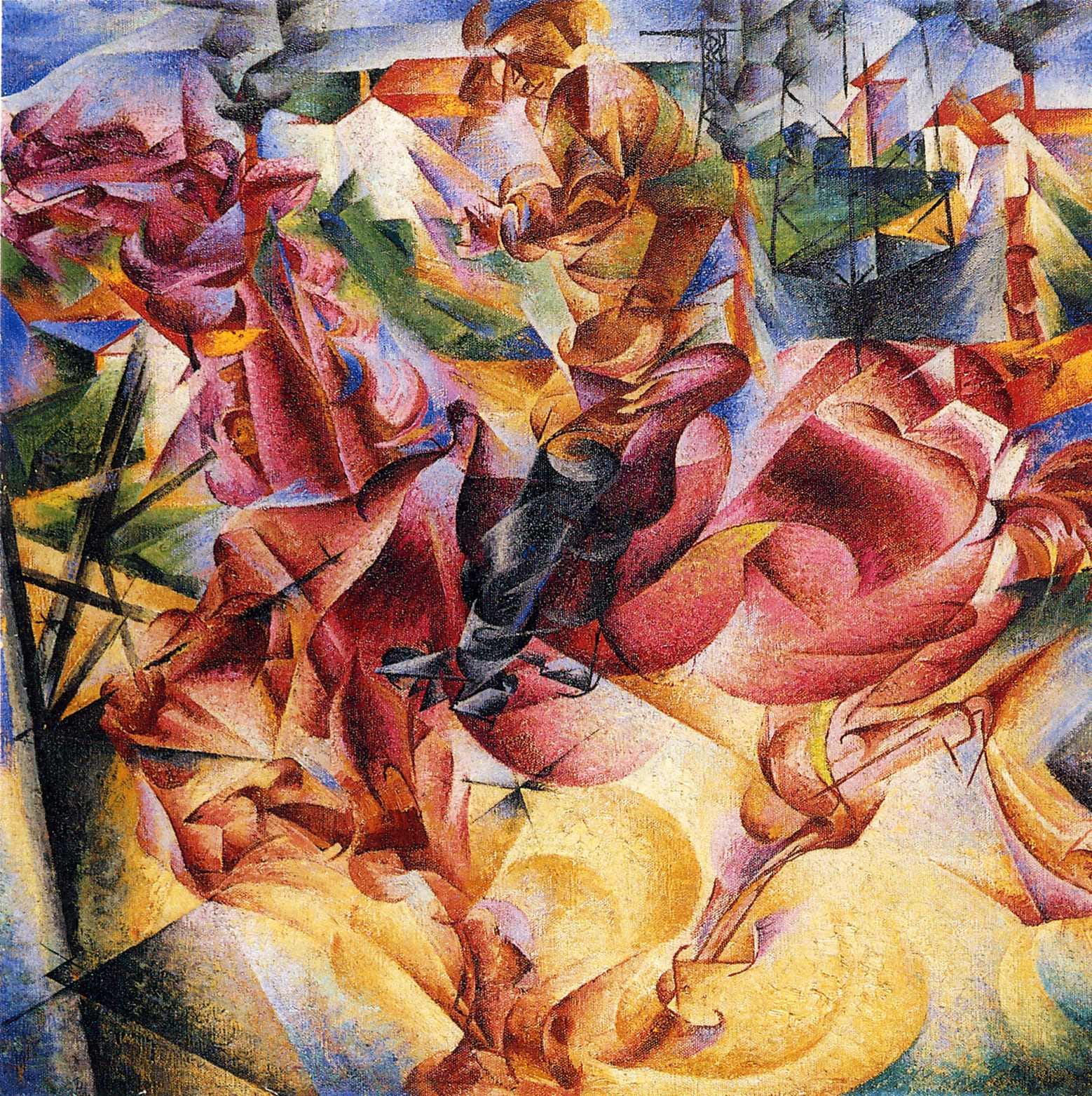
“Elasticity” - (1912) Umerto Boccioni
Introduction: A few weeks ago, I posted an essay “The Elasticity Factor: Can Zionists and Anti-Zionists Co-Exist?” available here. I was contacted by Canadian poet Ronna Bloom who read the essay and sent me a poem she had been working on that she said was in part inspired by the essay, and the notion of “elasticity” in this moment. I read the poem with great interest and offered to post it here (see below).
There is a tradition in Breslov Hasidism inspired by R. Nathan of Nemerov of taking Nahman’s homilies and creating prayer/liturgy from them. The interaction and interplay of the discursive and the poetic, cognition and creativity, is a time-honored tradition in the Jewish liturgical tradition and elsewhere.
Ronna’s poem in all its clarity, imagery, starkness, and pain, expresses to me what some of us are experiencing in this liquid moment of rupture and transition. Especially during these ten days of repentance, this poem resonated deeply. I hope it does so for some of you as well. May you all be showered with the white light of atonement and the renewed possibility a more just future. The Jewish traditional greeting in this time of “gemar hatima tova” “may the sealing of your past be complete, and may it bask in goodness” - Shaul
Ronna Bloom is a Toronto-based writer and the author of eight books of poetry. Her work has been broadcast on CBC, recorded by the Canadian National Institute for the Blind, and translated into Bangla and Chinese. It has also appeared in Best Canadian Poetry, Best Canadian Essays, and has been featured on The Slowdown with Maggie Smith. Her most recent books are A Possible Trust: The Poetry of Ronna Bloom (Wilfrid Laurier University Press 2023) and In a Riptide (Brick Books, 2025.) ronnabloom.com
Eventually
the elastic band of my belief
in an unimpeachable Israel snapped
and broke and I was free
to live in an excruciating reality
with everyone whose eyes were not already
shrouded and blinkered by post holocaust grief
and anticipatory panic, to live
with fear that is willing to proceed
with courage, pushing beyond
what it says is true to what is really true.
That no one is safe until everyone is free.
And if that means letting go of the fantasy
of a country that I was brought up to adore,
and whose ground I kissed at 16,
to see that it was never the pantheon
of good-guy justice I thought it was,
if it means letting go of a place I thought would
save and house a collectively unhoused me
at the expense of a collectively unhoused other,
if that means letting go of a heart inside my heart
and letting it break when it could no longer stretch
beyond the boundaries I was taught it had, then what
what is left in the snap of that break
is like the pop of a normative bubble I’ve lived in,
releasing me to the shocking emptiness
and spaciousness of anything happening, including
inclusiveness, love, equality, peace, and loss.
No, I couldn’t have it both ways. It broke. And I’m beginning
to feel the letting go let go, the sense of betrayal too, beginning
to feel the grief in my beginning to be glad.
Top of Form
Bottom of Form
Top of Form
Bottom of Form
Thank you Ronna Bloom and Shaul for posting this eloquent, heart rending private piyut. Ronna invites us to witness a heart breaking in slow motion. At this moment in our Jewish calendar, of spiritual introspection which perhaps can bring about personal and collective accountability, these words starkly and courageously express the breach and the painful path forward - where ever that may lead. Gmar Chatima Tova.
Thank you for sharing this stunningly beautiful poem about that experience I believe many of us have had. Gmar Chatima Tova and may we continue to pursue safety, freedom, justice, and dignity for all.